 Hero · 2400 × 1300Old and new contractor websites side by side on two monitors.
Foundation Repair Website Redesign Without Losing What Already Works
Foundation repair website redesign improves an existing contractor site while protecting valuable rankings, URLs, content, analytics, and lead paths.
Top Foundation Repair Marketing audits the current website before changing its structure or appearance. We identify what should be preserved, what needs improvement, and what requires a planned redirect or migration.
The result is a more credible, usable, and conversion-focused site without treating the existing marketing value as disposable.
- SEO & Content Preservation
- Modern Mobile Experience
- Stronger Conversion Paths
- Planned Migration & Launch QA
When Does a Foundation Repair Website Need a Redesign?
A website does not need to be replaced simply because it is a few years old. A redesign makes sense when the current site is preventing the business from communicating clearly, competing effectively, or converting qualified visitors.
Common signs include:
- The site is difficult to use on phones or tablets.
- Important service and location pages are hard to find.
- The design no longer reflects the quality or scale of the company.
- Pages load slowly or the platform is difficult to maintain.
- Calls to action, phone numbers, or inspection forms are unclear.
- Content is thin, outdated, inaccurate, or spread across competing pages.
- Organic traffic exists, but the site does not generate enough qualified inquiries.
- Marketing tools, forms, analytics, or integrations no longer work reliably.
The right response is not always a complete rebuild. Some websites need targeted improvements, while others have structural, technical, or content limitations that justify a broader redesign.
We begin by determining what should be preserved, what should be improved, and what should be removed or consolidated. That keeps the project focused on business performance rather than change for its own sake.
 Square · 1200 × 1200Analytics and conversion data being reviewed beside the current foundation repair website.
What Is a Foundation Repair Website Redesign?
A foundation repair website redesign is the structured process of improving an existing contractor website's content, architecture, appearance, usability, performance, and conversion experience.
Unlike a purely visual refresh, a strategic redesign starts with evidence. Existing organic landing pages, search queries, backlinks, URLs, forms, analytics, service content, and customer paths are evaluated before major changes are approved.
That assessment helps distinguish valuable assets from genuine problems. A page may look dated but still rank and produce leads. Another may be visually polished but attract the wrong traffic or fail to explain the service. The redesign should respond to those differences.
When URLs or platforms change, migration planning becomes essential. Redirects, canonicals, metadata, internal links, indexation settings, analytics, forms, and structured data must be carried forward or deliberately replaced.
The goal is a more useful and effective website with a managed transition—not a blank-slate project that ignores the value already built.
Foundation Repair Website Redesign Services
Website, SEO & Conversion Audit
We review the existing site's technical condition, organic visibility, priority landing pages, content, navigation, mobile experience, forms, analytics, backlinks, and conversion paths.
The audit establishes a baseline and identifies which assets deserve protection before design or development decisions are finalized.
URL Mapping & SEO Preservation Plan
Every important existing URL is accounted for. Pages may be retained, improved, consolidated, or retired based on their purpose and performance.
When an address changes, we map it to the most relevant destination and prepare permanent redirects. Titles, metadata, canonicals, structured data, internal links, and indexation rules are also reviewed as part of the migration plan.
Architecture & Content Restructuring
We reorganize the site around the company's current services, markets, and customer journey. Overlapping pages can be consolidated, weak service coverage expanded, and outdated information corrected.
The revised architecture should make it easier for homeowners and search engines to understand what the company does and where it works.
Visual, Mobile & Conversion Redesign
We update the visual system and page layouts to create a more credible, readable, and mobile-friendly experience. Calls to action, phone access, inspection forms, trust signals, and navigation are placed deliberately around the visitor's needs.
The design is built around approved content rather than hiding weak messaging behind decorative elements.
Development, Performance & Integrations
The redesigned site is developed with responsive behavior, maintainability, security, page performance, and accessibility in mind. Agreed forms, call tracking, CRM connections, analytics, chat, financing tools, and other integrations are configured and tested.
Third-party tools are evaluated for usefulness and reliability rather than added simply because they are available.
Migration, Launch & Post-Launch Monitoring
Before launch, we test redirects, links, forms, analytics, responsive layouts, metadata, crawl controls, and key integrations. After publication, we verify important URLs, conversion events, indexation signals, and technical behavior.
Search performance can fluctuate after a significant change. Monitoring helps identify migration errors quickly, but no provider can guarantee that every ranking will remain unchanged.
A Redesign Strategy Built Around Evidence
Protect Valuable Organic Assets
Existing pages may have years of search history, backlinks, local relevance, and user engagement behind them. Deleting or renaming those pages without a plan can make it harder for search engines and visitors to find the replacement content.
We use current performance data to guide the transition. Strong URLs and useful content are preserved where practical; redirects and consolidation are used when change creates a clear benefit.
Fix the Experience That Is Costing You Leads
A contractor website can receive traffic and still underperform. Slow pages, confusing menus, weak service explanations, hidden phone numbers, long forms, and generic calls to action all create unnecessary friction.
The redesign prioritizes the moments that matter: understanding the problem, choosing the relevant service, evaluating credibility, confirming service coverage, and requesting an inspection.
Build Around the Business You Have Now
Foundation repair companies evolve. Services change, markets expand, teams grow, technology improves, and earlier content may no longer represent the operation accurately.
We redesign the site around the current business and its realistic growth plans. The new structure can support foundation repair SEO, local SEO, paid campaigns, additional locations, and future conversion optimization without repeating the same rebuild a year later.
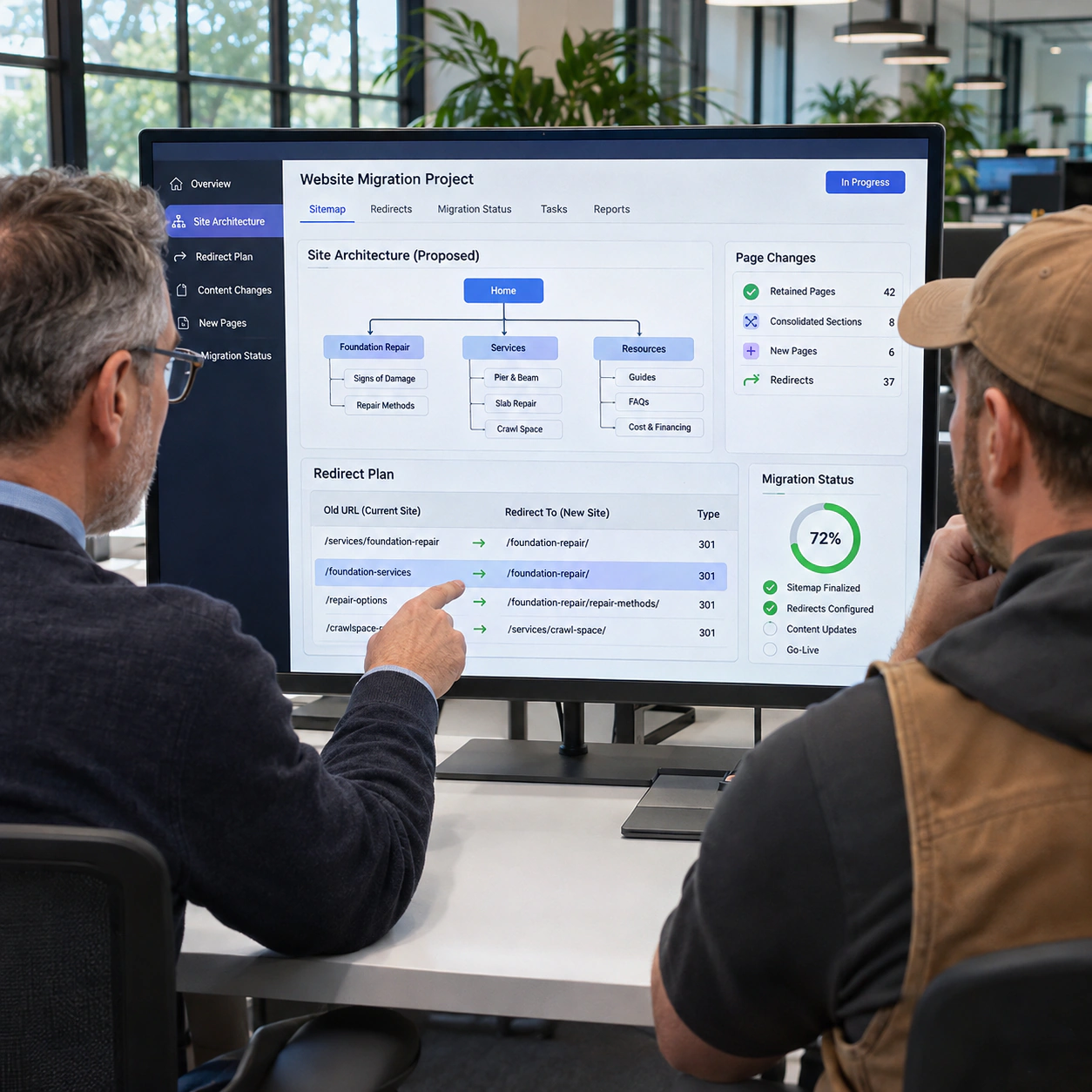 Square · 1200 × 1200Sitemap diagram showing retained pages, consolidated content, new sections, and permanent redirects.
How We Redesign & Migrate Your Website
Benchmark the Existing Site
We document current traffic, rankings, conversions, priority pages, URLs, content, backlinks, technology, and integrations. This creates the baseline needed to measure the transition and avoid unnecessary losses.
Define What Stays, Changes & Goes
We prepare the new sitemap, content plan, URL map, redirect requirements, and conversion strategy. Each major page receives a deliberate outcome instead of disappearing during development.
Rewrite, Redesign & Develop
Priority content is improved, approved layouts are designed, and the new site is developed. Reviews focus on factual accuracy, user experience, brand alignment, technical requirements, and the agreed business goals.
Test the Site & Migration Plan
We test representative devices and browsers, forms, links, tracking, integrations, metadata, structured content, redirects, indexation settings, and other launch-critical elements. Issues are resolved before traffic is sent to the new experience.
Launch, Verify & Monitor
After launch, we verify important URLs, redirects, forms, analytics, search-console signals, and crawl behavior. Performance is monitored so technical errors or unexpected changes can be investigated promptly.
Frequently Asked Questions About Foundation Repair Website Redesign
When does a foundation repair website need a redesign?
A foundation repair website needs a redesign when structural, technical, content, branding, or usability problems prevent meaningful improvement. Common signs include weak mobile performance, confusing navigation, outdated services, broken integrations, poor conversion paths, and an inflexible platform.
Will redesigning the website hurt Google rankings?
A redesign can affect rankings when URLs, content, links, performance, or crawl settings change. An audit, URL map, redirects, content preservation, technical testing, and post-launch monitoring reduce avoidable risk, but no agency can guarantee zero fluctuation.
Should the company redesign the site or make targeted improvements?
The choice depends on the severity of the current problems. Targeted improvements may be sufficient when the platform and architecture remain sound. A broader redesign is more appropriate when limitations affect many pages, systems, or conversion paths.
How long does a foundation repair website redesign take?
The timeline depends on page count, migration complexity, content, integrations, platform changes, assets, and approval speed. Established sites with many rankings and URLs need more planning and testing than small brochure sites.
Can the website move to another platform?
Yes, the website can move platforms when the change improves maintainability, ownership, performance, or functionality. The migration must account for URLs, redirects, content, forms, analytics, schema, integrations, media, permissions, hosting, and backups.
What content should be preserved during a redesign?
Content should be preserved when it is accurate, useful, relevant, and supported by traffic, rankings, backlinks, conversions, or customer value. Weak, outdated, overlapping, or inaccurate content may need revision, consolidation, or retirement with an appropriate redirect plan.
What should be tested before the redesigned site launches?
The site should be tested for redirects, links, forms, phone actions, analytics, conversion events, metadata, canonicals, structured data, mobile layouts, accessibility, browser behavior, indexation settings, integrations, and page performance.
How is redesign success measured?
Website redesign success is measured against the pre-launch baseline. Useful indicators include retained visibility, technical stability, mobile usability, engagement, calls, forms, qualified leads, booked inspections, and conversion performance after sufficient data accumulates.
 CTA · 2400 × 1200Designer and contractor approving the new homepage together.
Find Out Whether Your Website Needs a Redesign—or a Smarter Set of Improvements
Your current website may contain valuable pages worth preserving alongside technical, content, and conversion problems that are holding the business back.
We will assess the site, identify the highest-priority issues, and recommend a practical path based on your search presence, platform, marketing goals, and growth plans.