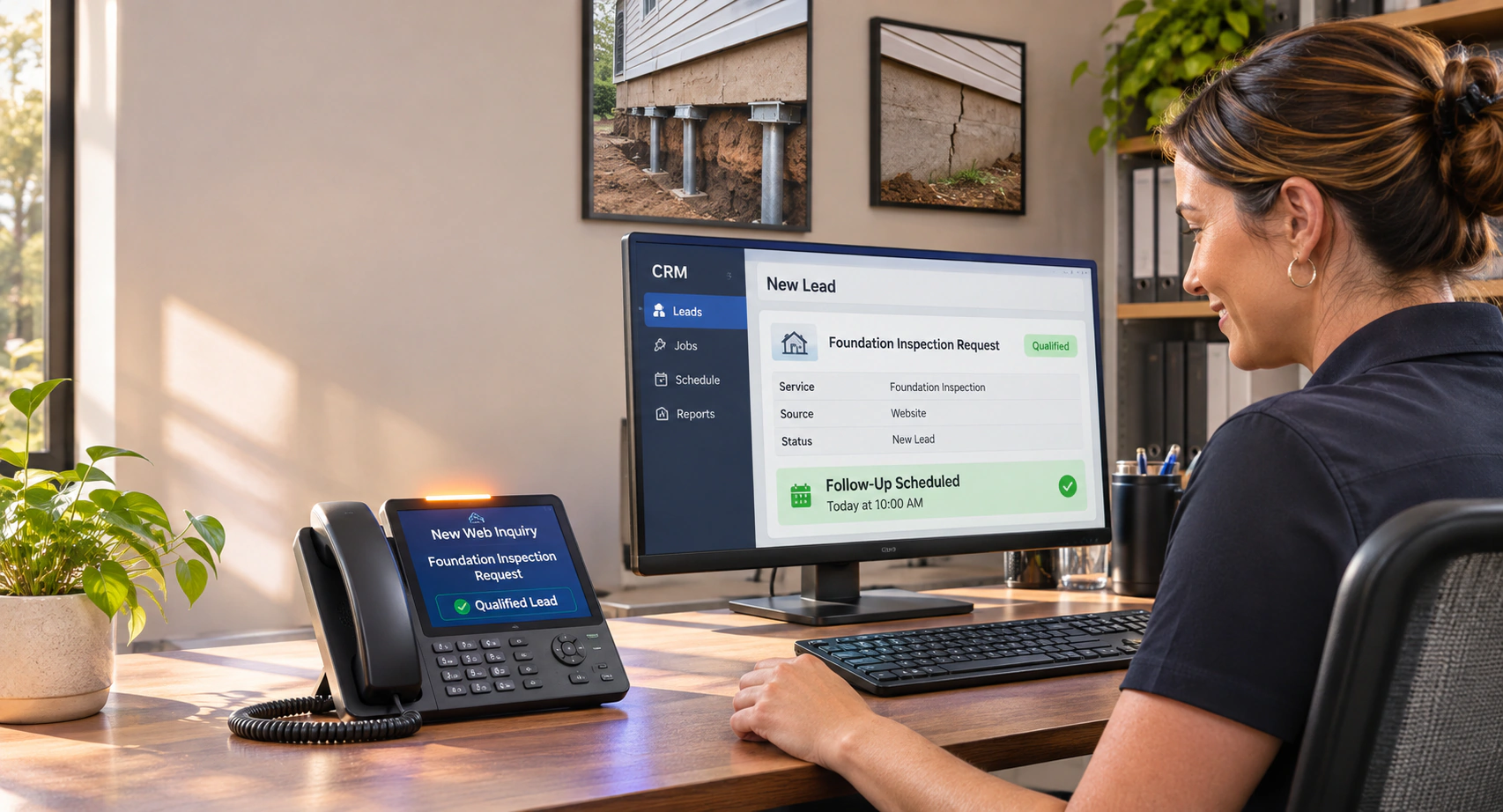
 Hero · 2400 × 1300Office phone lighting up with a new inspection request on a contractor’s desk.
Foundation Repair Lead Generation Built Around Qualified Opportunities
Foundation repair lead generation should produce more than names and phone numbers. It should connect your company with homeowners who need services you provide, live within your coverage area, and are willing to schedule an inspection.
Top Foundation Repair Marketing builds lead-generation systems for foundation repair, house leveling, basement waterproofing, crawl space repair, and structural repair companies. We combine search visibility, paid advertising, landing pages, conversion strategy, and tracking to help create a more dependable flow of relevant inquiries.
The goal is not the highest possible raw lead count. It is more opportunities your team can inspect, estimate, and convert into profitable projects.
- Qualified Homeowner Demand
- Multi-Channel Lead Acquisition
- Call & Form Conversion Tracking
- Inspection-to-Revenue Attribution
How Does Foundation Repair Lead Generation Work?
Foundation repair lead generation works by attracting relevant homeowners, converting their interest into calls or forms, and tracking what happens after the initial inquiry.
Homeowners may discover a contractor through organic search, Google Maps, Google Ads, Local Services Ads, social media, referrals, or another channel. Regardless of the source, the marketing needs to answer four questions:
- Is this homeowner looking for a service the company provides?
- Is the property inside the company's service area?
- Does the website or landing page establish enough trust to prompt contact?
- Can the office respond, qualify the request, and schedule the next step?
Lead generation breaks down when any part of that path fails. More traffic will not solve a confusing website. More form submissions will not help if they come from the wrong locations. More calls will not create revenue if no one answers or follows up.
Our approach connects acquisition, conversion, lead handling, and measurement. We assess which channels can reach the right homeowners, improve the path to contact, and use available sales data to identify which sources produce meaningful opportunities.
That creates a stronger basis for investing in marketing than cost per lead alone.
 Square · 1200 × 1200CRM pipeline showing new leads, qualified inquiries, booked inspections, estimates, and signed foundation repair jobs.
What Is Foundation Repair Lead Generation?
Foundation repair lead generation is the process of attracting homeowners who may need structural repair services and turning their interest into trackable calls, messages, forms, or inspection requests.
A lead is not automatically a qualified opportunity. Someone asking about a cosmetic crack outside the service area is different from a homeowner seeking underpinning for active settlement in a priority market. Lead quality depends on service fit, geographic fit, timing, contact validity, project potential, and the contractor's ability to respond.
Effective lead generation therefore includes more than advertising. It can involve foundation repair SEO, local SEO, Google Ads, Local Services Ads, landing pages, forms, call tracking, intake workflows, CRM stages, and revenue attribution.
The right mix depends on the market and business. A contractor with strong organic rankings but weak conversion paths needs a different strategy from a new company that needs immediate visibility. A multi-location operation also requires different routing and reporting than a single-market contractor.
The objective is a measurable system that supports profitable growth—not a disconnected collection of lead vendors.
Foundation Repair Lead Generation Services
Market, Service & Lead-Quality Analysis
We define the services, project types, locations, customer profiles, capacity, and economic conditions that make an inquiry valuable to your company.
Existing lead sources, sales outcomes, close rates, and job values are reviewed when data is available. This establishes what the marketing should pursue and what it should filter out.
Organic & Local Search Acquisition
We strengthen visibility for relevant service, problem, and geographic searches through SEO, local content, Google Business Profile support, and website improvements.
Organic acquisition takes time, but it can build a durable source of homeowner demand that reduces complete dependence on paid channels.
Paid Search & Lead Campaigns
We use appropriate paid channels to reach homeowners actively looking for foundation services. That may include Google Ads, Local Services Ads for eligible businesses, or other campaigns supported by the market and budget.
Keywords, job types, locations, ads, budgets, and exclusions are aligned with the company's real services and capacity.
Landing Pages, Forms & Call Conversion
We improve the experience between the first click and the inquiry. Pages answer essential questions, explain the service, show legitimate trust signals, and make it easy to call or request an inspection.
Forms are designed to capture useful qualifying information without creating unnecessary friction, and phone experiences are evaluated for mobile visitors.
Lead Tracking, Routing & Intake Support
We configure agreed tracking for calls, forms, source data, and campaign details. Lead-routing requirements are documented so inquiries reach the appropriate team, market, or service line.
We also help define intake stages and response expectations. Technology can support the workflow, but the contractor's team remains responsible for timely, accurate customer communication.
Qualification, Attribution & Optimization
We evaluate which channels generate valid contacts, qualified leads, scheduled inspections, estimates, signed work, and revenue when the data is available.
Campaigns and conversion paths are refined using downstream outcomes so budget decisions are based on business value rather than surface-level lead totals.
What Makes Foundation Repair Lead Generation Effective?
Are More Leads Always Better?
No. More leads are useful only when enough of them match the company's services, geography, capacity, and economics.
A smaller number of relevant inspection requests may create more revenue than a large volume of low-intent contacts. We define quality criteria with the contractor and use sales feedback to distinguish productive demand from noise.
Why Do Speed & Follow-Up Matter?
Speed and follow-up matter because homeowners often contact several contractors while comparing options. An unanswered call or delayed response can waste the cost and effort required to create the inquiry.
We help establish a clear intake path for calls, forms, messages, qualification, scheduling, reminders, and follow-up. Automation may support the process, but it should not replace appropriate human judgment or customer care.
Which Lead Metrics Matter Most?
The most useful lead metrics connect marketing cost with qualified business outcomes. These can include valid lead rate, inspection booking rate, estimate rate, close rate, acquisition cost, contract value, gross profit, and revenue by source.
Clicks and submissions are still useful diagnostics, but they do not show whether marketing produced profitable foundation repair work. Reporting should move as far down the sales pipeline as the available data allows.
 Square · 1200 × 1200Call-tracking and attribution report connecting marketing sources with inspections, estimates, and signed jobs.
How We Build a Foundation Repair Lead System
Define a Qualified Lead
We document valuable services, target markets, project types, exclusions, capacity, sales stages, and financial goals. A shared definition prevents the campaign from optimizing toward contacts the company does not want.
Audit Acquisition & Conversion Paths
We review current lead sources, website pages, advertising, local visibility, tracking, forms, call handling, routing, CRM data, and sales outcomes. The audit identifies the most important leaks and opportunities.
Launch or Improve Priority Channels
We focus first on the channels and conversion improvements most likely to create qualified demand. That may involve SEO, paid search, Local Services Ads, new landing pages, stronger forms, or corrected tracking.
Connect Leads to Intake & Sales Outcomes
We establish the agreed source tracking, lead stages, routing rules, and reporting. The contractor's team records what happened so marketing data can be compared with real inspections, estimates, and projects.
Optimize for Quality & Profitability
We adjust channels, budgets, targeting, messaging, pages, and workflows based on lead quality and downstream performance. Weak sources are corrected or reduced; stronger opportunities receive appropriate emphasis.
Frequently Asked Questions About Foundation Repair Lead Generation
How do foundation repair companies get more leads?
Foundation repair companies get more leads by improving visibility where homeowners search, creating trustworthy conversion paths, and responding effectively to inquiries. Common channels include SEO, Google Maps, Google Ads, Local Services Ads where eligible, referrals, social media, and targeted landing pages. The best mix depends on the market, budget, services, and sales capacity.
What is a qualified foundation repair lead?
A qualified foundation repair lead is a valid homeowner or decision-maker whose property, location, problem, timing, and service needs reasonably match the contractor. Qualification standards should be defined by the company because project value, travel limits, repair systems, financing, and capacity vary.
How much do foundation repair leads cost?
Foundation repair lead cost varies by source, market, competition, service type, season, targeting, and the definition of a lead. Cost per contact alone can be misleading. Contractors should also measure cost per qualified lead, booked inspection, estimate, and signed job whenever their data supports it.
Are exclusive leads better than shared leads?
Exclusive leads can reduce direct competition for the same contact, but exclusivity does not guarantee accuracy, intent, or profitability. Shared leads may cost less but can create more competition and pressure on response time. The better option is the one that produces acceptable customer-acquisition economics after lead quality and close rate are considered.
How long does foundation repair lead generation take?
Foundation repair lead-generation timelines depend on the channel. Paid campaigns may begin producing inquiries after launch, while SEO and local visibility usually require sustained work over a longer period. Tracking, lead volume, seasonality, competition, landing-page quality, and the sales process all affect how quickly reliable performance patterns emerge.
Should foundation repair companies buy leads or generate their own?
Foundation repair companies can use purchased leads, owned marketing channels, or both. Third-party leads may provide faster access to demand, but the contractor has less control over the customer experience and may compete with other companies. SEO, websites, local visibility, and first-party advertising take more work but can build assets and customer data the company controls.
How should foundation repair leads be tracked?
Foundation repair leads should be tracked from the marketing source through qualification, inspection, estimate, outcome, contract value, and revenue whenever possible. Call tracking, forms, analytics, advertising data, and CRM or job-management stages should use consistent source and status definitions so the business can compare channels accurately.
What causes foundation repair lead quality problems?
Common causes include broad targeting, inaccurate service areas, unclear ads, generic landing pages, missing negative keywords, unsuitable job types, weak forms, spam, poor intake, and inconsistent qualification. Lead-quality problems can also come from a mismatch between marketing promises and the services the contractor actually provides.
 CTA · 2400 × 1200Estimator shaking hands with a homeowner after an inspection.
Find Out Where Your Lead Generation System Is Losing Opportunities
Your company may need more visibility, better-qualified traffic, stronger landing pages, faster intake, or clearer attribution from the first click to the signed contract.
We will review your current lead sources, conversion paths, tracking, and sales data, then identify the improvements most likely to produce valuable foundation repair opportunities.